
Wondering how many watts per m² you actually need for underfloor heating? Get this right, and your system will feel warm, responsive, and cost-effective for years to come.
When I’m helping customers design a system, underfloor heating watts per m2 is one of the first numbers we look at. It tells us how much power your floor can deliver and whether it’s suitable as primary or just background heat.
In this guide, I will show you the usual wattage levels for electric and water systems. I will explain how to size them and how they affect running costs. You will also learn what to adjust for the best performance in a typical UK home.
Key Points:
- Manufacturers often provide underfloor heating wattage in watts per square metre (W/m²). This shows how much heat the floor can provide.
- Typical design ranges are 100 to 200 W/m² for electric heating. For water (wet) underfloor heating, the range is about 50 to 100 W/m². These ranges depend on heat loss and the type of floor.
- New buildings and well-insulated rooms need less underfloor heating power. This is true for each square metre. Older homes or rooms with many windows require more heating power.
- The right wattage makes the system more responsive and keeps running costs predictable.
- Good insulation, smart controls, and a proper design are just as important as the W/m² number on the box.
- What Does Underfloor Heating Wattage Actually Mean?
- How Many Underfloor Heating Watts per m2 Do You Need?
- 100W, 150W and 200W Electric Underfloor Heating – When to Use Each
- Wet Underfloor Heating kW per m2 Explained
- How Underfloor Heating Watts per m2 Affect Running Costs
- Electric vs Water Underfloor Heating: Efficiency and Wattage
- Factors That Change the Wattage You Need
- Thermostats, Controls and Using Underfloor Heating Efficiently
- Insulation and Floor Build-Up: Getting the Most from Your Watts
- Tips for Maximising Underfloor Heating Efficiency
- How UFHTS Can Help You Pick the Right Wattage
What Does Underfloor Heating Wattage Actually Mean?
When we discuss underfloor heating wattage, we’re profoundly discussing how much power your floor can supply to the room. We measure power in watts (W). If a system rates at 150 W/m², each square meter of heated floor can give off up to 150 watts of heat.
Most underfloor heating products are specified in watts per square metre (W/m²). That figure:
- Tells you the maximum heat output the system can deliver
- Helps you work out the total kW required for the room
- Lets you compare different systems and floor build-ups
To get the total underfloor heating kW per m2 for a room:
- Work out the heated floor area (excluding fixed units such as kitchen islands).
- Multiply that area by the W/m² of the system.
- Divide by 1,000 to get kilowatts (kW).
Example:
15 m² room × 150 W/m² = 2,250 W = 2.25 kW total output.
That’s the simple design side. The real skill is matching that output to your room’s heat loss, which is where building age, insulation, and glazing come in.
How Many Underfloor Heating Watts per m2 Do You Need?
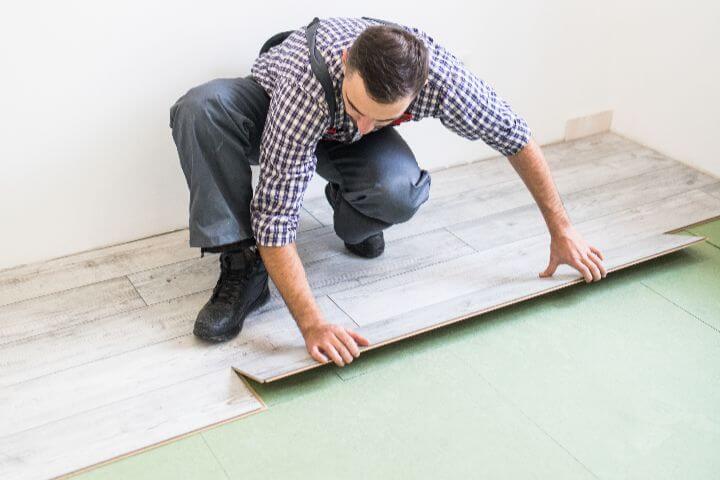
There isn’t a single “correct” number because every home is different. However, there are typical design ranges we use all the time when specifying systems for customers.
Typical Design Ranges (Indicative Only)
| Room / Building Type | Insulation Level | Typical W/m² Range (Electric) | Typical W/m² Range (Water) |
| New-build living space | Very good | 100–130 W/m² | 50–70 W/m² |
| Standard bedroom in 20–30 year old home | Average | 130–150 W/m² | 60–80 W/m² |
| Older property, moderate heat loss | Fair | 150–180 W/m² | 70–90 W/m² |
| Conservatory / lots of glazing | Higher heat loss | 180–200 W/m² | 80–100 W/m² |
| Bathroom with tiles over screed | Good (with insulation) | 150–200 W/m² | 60–90 W/m² |
These are typical working figures, not rigid rules. A proper heat loss calculation will always give you the most accurate underfloor heating watts per m2 for your project.
100W, 150W and 200W Electric Underfloor Heating – When to Use Each
Most electric mat systems in the UK are rated at 100 W/m², 150 W/m², or 200 W/m². I often see people pick a wattage purely based on price or habit, but choosing the right level makes a significant impact.
100 W/m² Electric Underfloor Heating
100 W/m² mats are the “gentle” option and work best when the building does a lot of the heavy lifting for you.
Good for:
- New builds and well-insulated rooms
- Bedrooms and living spaces with low heat loss
- Secondary heating under tiles or LVT (with another main heat source)
Modern building rules help reduce heat loss. Many new homes need only about 40–60 W/m² of heat to stay comfortable. A 100 W/m² mat gives you plenty of capacity without overshooting, especially with decent insulation under the system.
150 W/m² Electric Underfloor Heating
This is the most common choice I recommend for general domestic use, because it balances output and running time.
Good for:
- Kitchens, hallways, and bathrooms in typical UK homes
- Older properties that have some insulation but not to new-build standards
- Primary heating in average-sized rooms when designed correctly
150 W/m² gives you extra headroom for underfloor heating wattage without going overboard. It also responds quicker, as there’s more power available to warm the floor surface.
200 W/m² Electric Underfloor Heating
200 W/m² systems are powerful and need to be used in the right way.
Good for:
- High heat-loss areas like conservatories and north-facing rooms with big windows
- Small, tiled spaces where a fast warm-up is desirable (e.g. en-suites)
- Projects where you know heat loss is higher and the floor area is limited
Here, the higher underfloor heating watts per m2 help compensate for the tougher conditions. You don’t have to run the system flat out all the time, but you can use the capacity when you need it.
Wet Underfloor Heating kW per m2 Explained
With water (wet) underfloor heating, we still discuss watts per m², but more variables influence the output.
- Pipe spacing
- Flow temperature
- Floor build-up (screed depth, insulation)
- Floor finish
Typical wet underfloor heating kW per m2 figures:
- Well-insulated new builds: around 50–70 W/m²
- Standard homes and mixed-use rooms: around 60–90 W/m²
- High heat-loss areas: up to 100 W/m² with closer pipe spacing and suitable flow temperatures
Water systems use lower flow temperatures, especially with heat pumps. Designers usually create them to run longer, slowly warming the room. That’s why even a low wattage for underfloor heating can work well when builders construct the building properly.
For a full-house system with manifolds and multiple zones, consider dedicated water underfloor heating systems. These systems come as a complete package. They include pipes, manifolds, controls, and fixings that all work together.
Explore our full range of water underfloor heating systems.
Key info – quick sizing pointers
- New builds with good insulation: often fine with 50–70 W/m² (wet) or 100–130 W/m² (electric).
- 1970s–2000s homes: expect 60–90 W/m² (wet) or 130–150 W/m² (electric) for primary heat.
- Conservatories and big glazed areas: may need 80–100 W/m² (wet) or 180–200 W/m² (electric).
- Always confirm with a heat loss calculation, especially for older or unusual buildings.
How Underfloor Heating Watts per m2 Affect Running Costs
The wattage per m² sets the maximum capacity, but your running costs depend on:
- How often the system actually runs (duty cycle)
- Your room thermostat settings
- Your energy tariff (pence per kWh)
- How well insulated the building is
To work out the load:
- Total kW = (W/m² × heated floor area) ÷ 1000
- Energy used (kWh) = kW × hours the system is drawing power
- Cost = kWh × tariff (pence per kWh)
Example:
10 m² bathroom with 150 W/m² mats → 10 × 150 = 1,500 W = 1.5 kW.
If your tariff is 25p per kWh and the system draws full power for 1 hour, that hour costs about 37.5p. In practice, the thermostat cycles the system on and off, so average use is lower.
To see how different wattages, areas, and run-times affect your bills in more detail, it’s worth plugging your numbers into a calculator, try the underfloor heating cost calculator.
Electric vs Water Underfloor Heating: Efficiency and Wattage
Both system types use underfloor heating watts per m2 as a design metric, but they behave differently.
Electric Underfloor Heating
- Simple to install, especially for single rooms and refurbishments
- Typical ratings: 100–200 W/m²
- Great for bathrooms, loft conversions, small kitchens, and spot-warming projects
- Running cost depends directly on electricity price
Because the underfloor heating wattage is fixed by the mat or cable rating with electric underfloor heating kits, design choices revolve around:
- Picking the right W/m² band for the room
- Using insulation boards to reduce downward losses
- Choosing the right thermostat strategy
Water Underfloor Heating
- Ideal for whole-house or large-area heating
- Works well with condensing boilers and heat pumps
- Typical output: 50–100 W/m², tuned via pipe spacing and flow temperature
- Lower flow temperatures support high system efficiency, especially with heat pumps
With wet underfloor heating systems, you don’t just choose a fixed wattage. You design the floor to match the heat loss at your selected flow temperature. That’s why a proper design service or heat loss calculation is so useful before you order a kit.
Factors That Change the Wattage You Need
In real homes, these are the significant factors that affect underfloor heating kW per m2 requirements:
- Insulation level – If insulation is poor, heat loss increases. You might need more W/m² or an extra heat source.
- Glazing and external walls – Large glass areas and exposed corners lose more heat.
- Floor covering – Tiles and stone pass heat well; thick carpet and some wood products restrict transfer.
- Room use – A hallway that only needs background warmth is different to a main living space used all evening.
- Building age and construction – Solid walls, suspended timber floors, and uninsulated cavities all behave differently.
- Heat source – A system paired with a heat pump might feature lower flow temperatures than one that runs from a boiler.
This is why two rooms of the same size and floor finish can need different underfloor heating watts per m2. One room may face north with large, expansive windows, while the other is in the middle of the house.
Thermostats, Controls and Using Underfloor Heating Efficiently
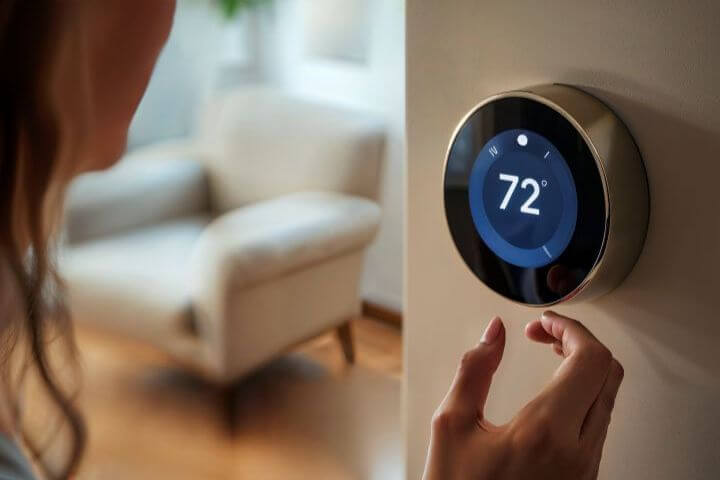
Even with the ideal wattage, an underfloor heating controller plays a significant role in comfort and running cost.
Types of Thermostats
- Manual thermostats – Simple dial thermostats; you set the temperature and leave it.
- Programmable thermostats – Let you schedule setback periods overnight or when you’re out.
- Smart thermostats – Offer app control, learning features, and detailed scheduling, very handy for electric UFH.
- Floor-sensing thermostats – Use a floor probe to manage surface temperature, useful under sensitive floor finishes.
Some homeowners prefer to keep the system running at a lower temperature. They do this instead of letting the property cool down completely. This is especially true for screed-based water underfloor heating systems that store heat in the floor. That approach can feel more comfortable and save energy in many homes.
Insulation and Floor Build-Up: Getting the Most from Your Watts
Whatever system you choose, good insulation lets your chosen underfloor heating wattage do its job properly.
Key points from real projects:
- Underfloor insulation boards beneath electric mats stop heat disappearing into the subfloor and speed up warm-up times.
- For wet systems, rigid insulation below the pipe layer is vital to push heat upwards.
- The combination of insulation + suitable floor finish often matters more than simply chasing a higher W/m² number.
Think of the floor as a big, gentle radiator. The better you direct the heat upwards, the more comfortable the room feels at a given wattage.
Tips for Maximising Underfloor Heating Efficiency
From day-to-day use, these are the habits that tend to work best:
- Make sure there is suitable insulation beneath the system before you finish the floor.
- Use programmable or smart thermostats to avoid heating rooms when they are not in use.
- Group rooms into sensible zones so you only heat the areas you actually need.
- Keep thick rugs and furniture without feet away from the main heated zones on the floor.
- Adjust settings gradually with the seasons instead of big temperature swings.
Over time, these tweaks help your chosen underfloor heating watts per m2 work smarter, not harder.
How UFHTS Can Help You Pick the Right Wattage
When I help customers pick between electric mats and water underfloor heating, we start with the same questions. We ask about room size, insulation level, and how you use the space. From there, we can recommend the best underfloor heating wattage and a kit that fits your floor build-up and heat source.
On the main site, you will find full water and electric systems, manifolds, controls, and accessories. You will also get support from people who use these products every day.
Conclusion
Getting underfloor heating watts per m2 right is about more than picking the biggest number on a brochure. It’s about matching output to heat loss, choosing between electric and water systems, and building a floor that lets the heat reach the room.
With the right design, insulation, and controls, both electric and wet systems can provide comfortable, even warmth at a sensible running cost. If you’re unsure where to start, use the underfloor heating cost calculator and reach out for tailored advice on your project.
FAQs
How big of an area will 1500 watts heat?
It depends on the W/m² rating and the room’s heat loss. At 150 W/m², 1,500 W (1.5 kW) would cover around 10 m² of heated floor area (1,500 ÷ 150 = 10). The effectiveness of heating the room on its own depends on insulation, glazing, and how you use the space.
How many kW is underfloor heating?
There isn’t a single figure. The underfloor heating kW per m2 is set by the system’s W/m² rating. To find the total kW for a room, multiply the W/m² by the heated area and divide by 1,000. For example, 20 m² at 150 W/m² gives 3,000 W, which is 3 kW of potential heat output.
How many watts per m2 for heating?
In many UK homes, underfloor systems are typically designed between 50–100 W/m² for wet systems and 100–200 W/m² for electric, depending on insulation, building age, and room type. A heat loss calculation will always give the most accurate underfloor heating watts per m2 for your specific project.
Sources
eFunda (n.d.) Glossary: Units: Thermal Heat Transfer Coefficient: Watt Per Square Meter Per Degree Celsius. Available at: https://www.efunda.com/glossary/units/units–thermal_heat_transfer_coefficient–watt_per_square_meter_per_degree_celcius.cfm [Accessed: 21 November 2025]
